Showing posts with label Experiment. Show all posts

Monday, June 4, 2012

Batch No. 55 - Theme from the Barrel No. 2

Theme from the Barrel No. 2

Brewed - June 3, 2012

Style - Imperial Porter


Ingredients:
  • 11.0 lbs. American 2-Row
  • 9.0 lbs. Maris Otter
  • 5.0 lbs. Rauch Malt
  • 3.0 lbs. Midnight Wheat
  • 2.0 lbs. Crystal 60L
  • 1.5 lbs. Sugar in the Raw
  • 1.5 lbs. Chocolate
  • 1.0 lbs. Crystal 90L
  • 1.25 oz. Centennial (90)
  • 0.75 oz. Cascade (90)
  • 0.75 oz. Cascade (30)
  • Safale US-05 Dry Yeast (3 packs / no starter)

OG - 1.092
Primary – 25 days
Barrel - ?? days
Secondary - ??? days

Transferred to the barrel -June 28, 2012

Kegged - ???

FG - 1.021
Attenuation - 77.2% 
ABV - 9.3%


Notes:
  • Finally brewing one of my favorite styles, an Imperial Porter
  • Fermented beer will be dumped into my 7.5-gallon Rye Whiskey Barrel from Woodinville Whiskey Company, which was recently emptied of the American Barleywine
  • I'm hoping to get one more good turn out the "fresh" barrel and fuse the imperial porter with the rye whiskey notes; afterwards I will strip and clean the barrel to either use for a few fresh oak beers or turn it loose for sour beers 
  • Barrel was rinsed with warm water after transferring out the barleywine and then I burned a sulfur stick in the barrel to prevent microbial growth while it sits for approximately 3 more weeks until the new imperial porter is ready; ideally I would have been more on top of this to have it ready closer to the emptying of the barrel, but I've been busy with NHC beers and the barrel flavors really took off into the barleywine the last 1.5 weeks before transferring it out
  • Mash at 152° for 90 minutes
  • Turbinado Sugar was added into the boil @ 30 mins to help bump ABV and fermentability
  • 90 min boil
  • First time using Midnight Wheat malt and the wort had a gorgeous chocolate cappuccino layer as it approached boiling
  • I got a normal ~ 10 gallons with this batch, so unlike the barleywine where I used 100% for the barrel, I will have ~ 2.5 gallons of base beer to compare to the barrel-aged version
Updates:
  • Hydrated the barrel with water for 2 days prior to transfer
  • Transferred to the barrel on June 28, 2012
  • Gravity at transfer was 1.021 for a 9.3% ABV
  • Transfer to the barrel much easier the 2nd time around!!
  • The barrel is definitely bigger than the listed 7.5 gallons; closer to 8.5 gallons and will measure it next time I clean it out

Tuesday, May 22, 2012

Batch No. 53 - The Alpha Acid Test

The Alpha Acid Test

Brewed - May 18, 2012

Style - American Pale Ale


Ingredients:
  • 10.0 lbs. Maris Otter Pale
  • 7.0 lbs. Gambrinus 2-Row
  • 1.0 lbs. Munich Light
  • 0.4 lbs. Crystal 20L
  • 0.4 lbs. Crystal 40L
  • 0.4 lbs. Biscuit
  • 0.90 oz. Chief #3 / P9-VA517005 (60)
  • 0.60 oz. Chief #3 / P9-VA517005 (10)
  • 0.25 oz. Chief #3 / P9-VA517005 (5)
  • 0.25 oz. Chief #3 / P9-VA517005 (1)
  • 1.30 oz. Chief #3 / P9-VA517005 (dry hop - keg #1)
  • 2.00 oz. Chief #2 / P9-VA436007 (dry hop - keg #2)
  • Wyeast #1056 American Ale (2 packs / 1000 ml starter)

OG – 1.052
Primary – 9 days
Secondary - ?? days (dry hopped)

Kegged - ??

FG - 1.006
Attenuation - 88.5%
ABV - 6%

Notes:

  • American Pale Ale brewed with some new experimental, high alpha hops
  • We received 7 types of experimental hops from Hop Union to be used at our discretion for a beer to pour at NHC; they were all high alpha hops and based on comparing the aromas, I choose one to be the "single" hop to get me to ~ 40 IBU's
  • I figured a simple Pale Ale would be a good way to go to really see how the hop does in bittering and flavor 
  • I used Chief #2 / P9-VA517005 (15.5% alpha, 5.6% beta) for all hop additions and will dry hop one keg with the 1.3 oz. that remain
  • I will use some Chief #3 / P9-VA436007 (17.6% alpha, 6.4% beta) for dry hopping the 2nd keg
  • Both of these hops had a nice, fruity, spicy aroma and quite a few others were heavier on the garlic, onion side that I tend not to like that much; we weren't given any flavor profiles, so we'll see how the flavor works out 
  • Mash at ~ 152° for 60 minutes; 60 min boil
  • Fermentation started in the low 70's

Monday, May 7, 2012

Batch #51 - Saison de Soufflé Fleur

Saison de Soufflé Fleur

Brewed - May 5, 2012

Style - Saison

Ingredients:
  • 27.0 lbs. Pilsner
  • 5.0 lbs. Red Wheat
  • 2.0 lbs. Munich Light
  • 1.0 lbs. White Wheat
  • Perle - 3.0 oz. (60)
  • Saaz - 2.0 oz. (30)
  • Dandelion Tea - 32.0 fluid oz. (1.1 oz. dry dandelion leaf tea)
  • Wyeast #3711 French Saison (1200 ml starter / 3 packs)

OG –1.068
Primary – 13 days
Secondary - ?? days

Kegged - ??


FG - 1.005 
Attenuation - 92.7%
ABV - 8.2%


Notes:
  • Collaboration brew with fellow homebrewing aficionado Bob Zormeir
  • After trying Fantome Pissenlit years ago, I have long wanted to try to brew a dandelion saison; with NHC coming up, this was one the beers I wanted to finally get brewed 
  • In this case, we brewed the beer together and each are trying a different method with the dandelions
  • On the fly, we scaled up a recipe that Bob has worked up; I had never brewed a 15-gal batch on this system, so it was a learning process
  • I didn't estimate the pre-boil runoff correctly and we ended up with 13.5 gallons and overshot the targeted OG
  • Bob took ~ 5 gallons home with him and when fermentation slows, he will be adding a tea he made with fresh dandelion flowers and a different saison yeast (Wyeast #3724 Belgain Saison I think)
  • I made up some strong dandelion tea an dumped ~ 32.0 liquid ounces into the fermenter before the transfer; ~ 5 gallons were transfer on top and I will be adding more tea depending on flavor, strength, etc.
  • The remaining ~ 3.5 gallons will be fermented as is with no dandelions and hopefully will turn out to be a tasting wheat saison 
  • We both plan on serving our saisons at the NHC Club Night and it will be interesting to taste the different results 
  • Mash at 152° and 90 min boil
  • Start the ferment ~ 72° 

Updates:
  • Wyeast #3711 is a workhouse and this was down to 1.005 in 13 days
  • On May 18th, I added ~ 40 oz. of dandelion tea to 4.5 gals of saison in one keg; I have ~ 3.5 gals in the other and will either leave as is as a base or will use some to blend into the dandelion keg depending on how it tastes in a few weeks 

Friday, April 27, 2012

Transfer to the Barrel

After a long, slow ferment that including re-pitching some dry yeast, the Theme from the Barrel No. 1: American Barleywine was finally ready to transfer into the rye whiskey barrel.  The ~ 2.5 gallon carboy fermented down to ~ 1.028 and the ~ 5.0 gallon carboy fermented down to ~ 1.034.  Not quite as low as I had hoped, but it tastes pretty good and we'll see how it turns out after some time in the barrel.  So that comes out roughly to 1.032, 72% attenuation and a hefty 10.6 % ABV.  The barrel should add a little to the ABV.

One bummer though is that I didn't quite have enough barleywine to top off the barrel, so I had to add a little bit of Shore of the Baltic Sea (the only other dark, strong beer I have going right now).  Didn't quite get the runoff I thought I got during the brewday and my math must have been off somewhere.  I had hoped to have ~ 1 gallon or so to keep around to top off every so often as the beer was absorbed into the barrel, evaporated, etc. but I'll just have to do that with the baltic porter instead.

I'll give it some time and give a taste in the next month or so.

Friday, March 16, 2012

The Barrel Room is born ;)

Barrel aging on my own is now a reality!!  Last week I purchased a 7-gallon oak barrel from Woodinville Whiskey Company that was recently emptied of their Rye Whiskey.  For the first use, I will be filling it with the American Barleywine brewed last weekend.  The hope for this first use is to age the Barleywine in the barrel and extract oak and rye whiskey flavors.  Then soon after that is transferred out, to get a 2nd use of it with perhaps an Imperial Porter.  After that I think most of the rye whiskey flavors will be stripped out and then the barrel will have to be cleaned-up for future use as a sour barrel or maybe even some oak-aged saisons (yum!!).  I know plenty about drinking barrel aged beers but next to nothing about making them and using a barrel, so this is very exciting and there will be plenty of updates to come!!     


Monday, November 7, 2011

Batch No. 40 - Squashes Me with Fear

Squashes Me with Fear

Brewed - November 6, 2011

Style - Smoked Squash Brown Ale


Ingredients:
  • 11.0 lbs. American 2-Row
  • 5.0 lbs. Pilsner
  • 4.0 lb.s Munich Light
  • 2.0 lbs. White Wheat
  • 2.0 lbs. Smoked Hubbard Squash
  • 1.0 lbs. Crystal 80L
  • 1.0 lbs. Crystal 60L
  • 1.0 lbs. Flaked Barley
  • 0.5 lbs. Melanoidin
  • 0.5 lbs. Carafa Special
  • 1.0 oz. Cascade (60)
  • 1.0 oz. Cascade (30)
  • 6.0 lbs. Smoked Hubbard Squash (20)
  • Wyeast #1056 California Ale (1500 ml starter / 300 ml pack)

OG – 1.064
Primary – 13 days
Secondary - 14 days

Kegged -December 3, 2011

FG - 1.013
Attenuation - 80%
ABV - 6.7%


Notes:
  • Finally brewed the long discussed smoked squash beer
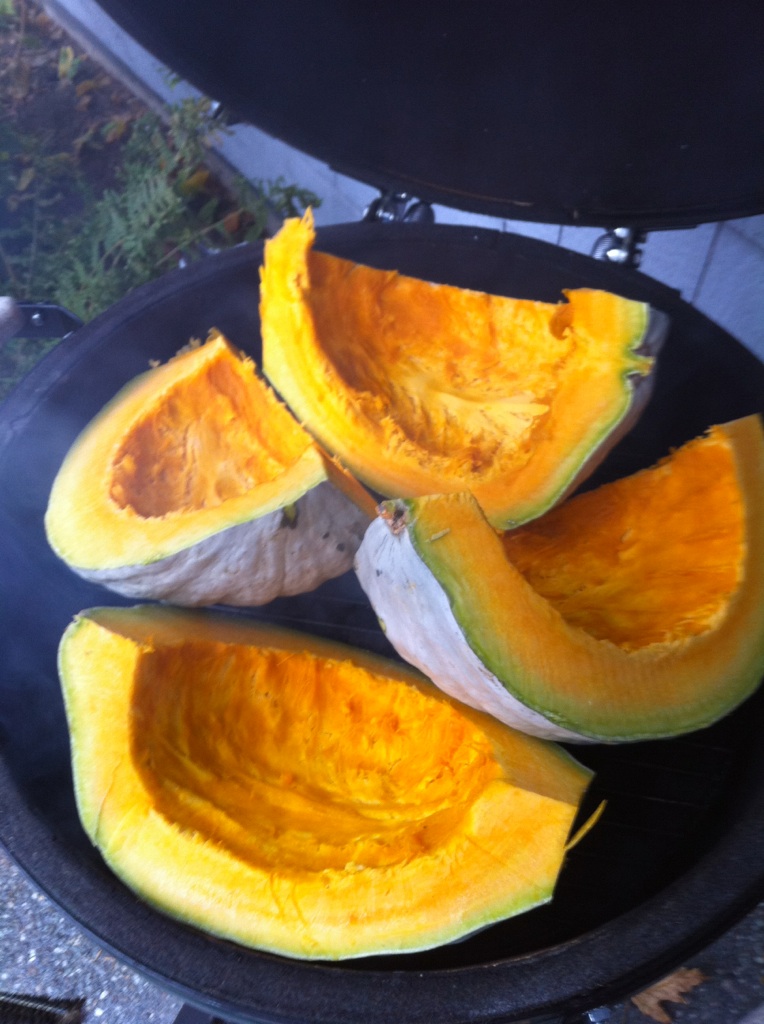
  • Brandon smoked up a 12-lb. hubbard squash on his BGE (Big Green Egg); slowly smoked for approx. 3.5 hours I think; once finished it had a much more pronounced campfire aroma and tasted quite sweet; decided against adding any smoked malt into the mash so we can see just how much smoked flavor comes off the squash
  • Huge thanks to The Mad Fermentationist for inspiration and recipe guidance. I'm thinking of possibly souring one of the kegs after primary is done depending on how it turns out; possibly adding some spices in the secondary as well
  • Mash at 154° for 80 minutes
  • 2.0 lbs of smoked squash in the mash and 6.0 lbs in the boil (20 mins)
  • 90 minute boil


Wednesday, June 16, 2010

Fruit Treatments

June 15, 2010

Split my wheat beer into my 3-gallon carboys (gravity was 1.011 at transfer) and added two different fruit treatments. Both were a mix of fresh and store-bought frozen fruit. The fresh fruit was cleaned, frozen and then thawed for blending.

Mango/Peach Blend
  • passionfruit not in season, so went with peach and mango
  • 2 big, fresh mangos (green skin)
  • 4 small, fresh mangos (yellow skin)
  • 2 fresh peaches
  • 1 lb. frozen peaches
  • blend resulted in ~ 4.75 cups fruit puree

Berry Blend
  • 1 qt. fresh raspberries
  • 1 qt. fresh blueberries
  • 1 qt. fresh blackberries
  • 1 lb. frozen wild berry blend mix
  • blend resulted in ~ 4 cups of fruit puree

Friday, June 11, 2010

Batch No. 24 - American Wheat w/ Fruit

American Wheat Ale

Inspired by a recent issue of Zymurgy, the plan here is to brew an american wheat, split in half and treat each 2.5 gallons with a different fruits in the secondary. Current idea is to treat one half with a mixture of passionfruit and mangos, with the second half getting a mixture of berries (raspberries, blackberries, blueberries).

Brewed - June 6, 2010
Style - American Wheat
Source - Zymurgy / NHB

June 15, 2010 - Fruit Treatments

Ingredients:
  • 6.0 lbs. Wheat LME
  • 1.0 lbs. Bavarian Wheat DME
  • 1.0 lbs. German Munich Malt (partial mash)
  • 0.7 lbs. Flaked Wheat (partial mash)
  • 0.5 oz. Mt. Hood (60)
  • 0.5 oz. Mt. Hood (30)
  • 1.0 tsp. Irish Moss (15)
  • 0.5 oz. Cascade (10)
  • 0.5 oz. Cascade (KO)
  • Wyeast #1056 American Ale (2 packs)

OG – 1.056
Primary - 8 days
Secondary - TBD

Bottled - TBD

FG - TBD
Attenuation - TBD
ABV - TBD

Notes:

  • Partial Mash 2 gals @ 150 for 60 mins; sparge 2 quarts 170 water
  • 750 ml starter
  • used two packs of old 1056 yeast (maybe in my fridge for ~ 11 months?)
  • net 2 gallons from sparge
  • will split this batch in half and treat each with different fruits
  • I was concerned about the yeast and slow start, but this was down to 1.011 at transfer
  • Fruit blends added 6/15/10

Starter made in a growler now since I smashed my big beaker


First sample - Saison de Deux Médecine w/ Brett

February 17, 2010 - After 143 in the secondary, I pulled my first sample the Saison de Deux Médecine w/ Brett and did a side by side with the a bottle of the regular version. Honestly, I was just excited that it wasn't disgusting!! The surface of the beer in the carboy has a spotty light white, almost puss looking foam on top, but tasted great. Still a way off from bottling though.

1. Saison de Deux Médecine w/ Brett
  • Pulled sample, so no carbonation
  • Clear light gold w/ fruity brett and zing on the nose
  • Yarrow seems covered up a bit
  • Dry with mild sweetness and sticky mouthfeel
  • Zing with leathery brett and mild fruit

2. Saison de Deux Médecine
  • Over-carbonated like the other bottles
  • Slight haze and dull yellow
  • Lemony yarrow with ginger and citrus flavors
  • Chalky and smooth
  • Lots of ginger in this bottle

Wednesday, June 9, 2010

Batch No. 20 - All-Grain Smoked Baltic Porter

Smoked Baltic Porter

Brewed - February 6, 2010

Style - Baltic Porter

For quite a long while, I’ve wanted to brew a really big (~ 10%), possibly smokey, baltic porter. Traditionally, a baltic porter is brewed with lager yeast and accordingly lagered (cold fermented) for a period of time. I don't really have the means to brew and condition a lager, so this was an obvious choice to brew on Colin's all-grain system.

While I've always loved porters and more recently baltic versions (Smuttynose Baltic Porter is one of my favs), I'm more of a newcomer to smoked beers. And true be told though that I'm not quite there yet in terms of enjoying the traditional and extremely smoky examples like Aecht Schlenkerla Rauchbier Märzen. But I do enjoy smoked lagers and the wide variety of porters/stouts that use wither smoked or peat malt to add a layer of complexity.

For this beer, my inspiration came from Thisted Limfjords Porter/Double Brown Stout, which has a nice, subtle smokey character.

I found some recipes online and after some back and forth with Colin's help, we came up with a good looking recipe. I don't have exact notes from the brewday, but here's a rough recipe:

Ingredients:
  • 50% - Pale Malt / 2 row
  • 30% - Cherrywood Smoked Malt
  • 15% - Munich Malt
  • 2.5% - Carafa II
  • 2.5% - Special B
  • 2.5% - British Chocolate
  • Hops: Hallertauer ~ 30 IBU's
  • Yeast: Wyeast #2206 Bavarian Lager
  • Mash @ 150° for 60 mins
  • Pitch @ 48°
  • Lager/Ferment @ 50° in Colin's fridge

One of the exciting things about this beer was that the Cherrywood Smoked Malt was a relatively new malt available to homebrewers. Since there wasn't much info to go on in terms of intensity and flavor, one thought we had prior to brewing was to brew two beers - a strong baltic porter and a rauchbeer - and then blend together accordingly. But in the end we bailed on that idea with concerns of the the depth of the smoke flavor and thinning of the body.

Anywho, it was a successful brewday and great learning experience going through the whole process of grinding up the grains, mashing, etc. We had some much grain (maybe 28 lbs. or so if I remember right?) that the mash tun was basically filled to the brim! Original gravity was in the neighborhood of 1.150.


Post brewday updates........

Primary fermentation went pretty much according to plan and samples has a big does of sweet smoke, texture was thinner than expected and color was also a little light (dark, cola brown). For the extended lagering, the beer was transferred into corny kegs for storage in the fridge. This where we ran into some trouble. Somewhere along the line (probably in the transfer or the corny kegs themselves), the beer picked up a little infection. Over a few weeks, the infection bugs took over effectively ruining the beer!!

Now I've never had on infected beer, so I can clearly dump this all on Colin!! LOL, just kidding. Crap happens and while definitely a bummer that 10 gallons went down the drain, there is still some cherrywood smoke malt left and we will give it another go

Turns out too that this was the last batch I worked on at Beacon Hill Brewing, but looking forward to brewing a few times with Colin this summer at his new set up in Brier.

Tuesday, June 8, 2010

Wallonia Update / Brettanomyces

Updates on the Wallonia saison and finally time for Brettanomyces......

September 17, 2009


Pulled a sample of Wallonia....
  • gravity down to 1.012
  • getting clearer w/ fruity lemons and orange on the nose
  • sample has a sharpness to it with dry, husky, sweet malt and dried fruit
  • very dry on the finish but overall still on the sweet side
  • at this point it has been in the primary for over 50 days!!!

September 27, 2009

Finally transferred the Wallonia today. All in all in spent 64 days in the primary!! To me that is crazy and scary on many levels, but this sucker just would not ferment. The sample at transfer is just a hair over 1.010. I had hoped it would be more like 1.006, but I still got over 86% attenuation.

And now that it is finally transferred into the secondary, it is finally time to break out the big, bad brett!! I'm splitting the package of brettanomyces claussenii, so the 2.5 gallons of Two Medicine has been patiently waiting for this day.

I split open the package and split the yeast evenly ~ 100 ml each. Wow, brett smelled amazing with sour pineapples and thick fruity nose; color is muddy dark yellow.

Now the waiting game begins for the brett to do its thing and I’ll bottle in maybe 5 months?

Monday, July 27, 2009

Saison Experiment

A few notes on my saison experiement:

1. Saisons
  • In the words of K. Florian Klemp, "The French word for season, saison, has become a stylistic designation to distinguish a group of beers from Wallonia, the French-speaking region of Belgium. Today, these historically seasonal ales are brewed year-round. Saisons present a complex character that is both aggressive and subtle. Unmistakably Belgian and unequivocally rustic, they beckon exploration. "
  • BCJP style description
  • Ever since I first tried beer on my 21st birthday, porters have always been my favorite style. But over the last year or so, saisons have been giving it a run for the money.
  • My idea was to do two different saisons: the first would be more traditional and get its spicy characteristics directly from a specific saison-style yeast; the second would use a more neutral belgian yeast and get flavor from the additions of spices and wildflowers
  • Notable commercial examples: Boulevard Saison w/ Brett, Dupont Avec les Bons Voeux, Fantôme Saison, Moinette Biologique, Saison Dupont Vieille Provision, Southampton Cuvee des Fleurs and The Bruery Saison de Lente

2. Fermentation Temps

  • While the general rule of thumb ale yeasts seems to be fermentation around 70 degrees on the high end, saison yeasts are recommended at 80 degrees or even higher
  • That makes them perfect for summer and the higher temps should bring out the spice and fruity esters that saisons are known for
  • I'm 4 days into Rêve de Wallonia and 3 days into Saison de Deux Médecine and have been keeping them in the kitchen for the most part to maximize the heat
  • Ambient temps have been mostly in the 80's, reaching as high as 92 (!!)
  • Fermentation has been strong and I will be taking samples in the next 3-4 days

3. Spices / Wildflowers

  • Previously I've used a few spices (corriander, grains of paradise) in an Imperial Wit, but here I used several new to me.
  • In the tradition of using local ingredients, I wanted to use wildflowers picked while on a backpacking trip. I picked a bunch, but many turned out to be inedible. Yarrow however worked. The dried yarrow I got was from Eastern Washington and the wildflower honey from Western Washington.
  • I like the general idea of using wild ingredients and plan on doing a spruce tip IPA soon

4. Brettanomyces
  • Another layer to this experiment was to use Brettanomyces wild yeast for the first time
  • Vinnie Cilurzo of Russian River Brewing: Brettanomyces (also known as Brett) is feared by most brewers and winemakers alike. In fact, there are some local winemakers who will not set foot in our brewpub in Downtown Santa Rosa due to our use of Brettanomyces. Brettanomyces is actually yeast, it ferments and acts the same as every other "conventional" yeast, it just has the propensity to continue fermenting through almost any type of sugar, including those natural sugars found in the wood in an oak barrel. Brett is very invasive and if not handled properly can become out of control in a winery or brewery, but, if used properly with care, it can add rich aromas and flavors of earthiness, leather, smoke, barnyard, & our favorite descriptor-wet dog in a phone booth.
  • While used for many years in classic beers such as Orval, brett has become quite popular in recent years and has been showing up in saisons as a secondary yeast
  • My choice: Wyeast 5151-PC Brettanomyces claussenii - Isolated from English stock ale, this wild yeast produces a mild Brett character with overtones of tropical fruit and pineapple. It ferments best in worts with a reduced pH after primary fermentation has begun. May form a pellicle in bottles or casks. Typically used in conjunction with other yeast and lactic acid bacteria.
  • Brett will certainly change the flavor of my beers and should also help them attenuate and dry out - something you want in a saison
  • Using brett will requiring purchasing some new equipment, hoses, etc. b/c you can't rid the critters from anything that is porous; glass carboys will be fine

5. Batch Splitting
  • I'm doing several new things with these two beers with the big one definitely being the brettanomyces
  • In order to fully understand its impacts on each recipe, I will be only using it in part of each beer
  • I will take each beer, split in half and only put brett in half; thus ending up with essentially four different beers
  • The results should go along way in understanding not only brett, but also the high fermenation temps, use of spices, etc.
  • This is something I plan on continuing in the future in regards to using oak again, adding fruit, etc.